Prior to the World Cup 2022, I had only ever watched one World Cup match. About 12 years ago, when I was in the US, a German friend invited me over to watch a match with her and a group of fellow football enthusiasts. All I remember from that experience is that Germany played. At the time, I could not understand the strategy and pacing of the match, so I was not able to appreciate the sport nor the fervor surrounding it. In comparison, the World Cup 2022 has been a crash course for me—I attended or watched matches at every stage of the tournament—and the tournament has been more immersive for me since it took place entirely in Qatar, where I reside. In fact, part of the reason why I now live in Qatar is because of the World Cup 2022.
Five years ago, I was applying for work to multiple domestic and international institutions of higher education. In the US, my applications did not seem to generate much interest. However, two international institutions were interested in me: one in Saudi Arabia and the other in Qatar. Both offered lucrative packages, but for me, what tipped the scales in favor of Qatar was that they would be hosting the World Cup 2022. By all accounts, the country was developing at a rapid pace in preparation for this major sporting event, and part of me wanted to see this development firsthand and possibly attend the tournament. With the World Cup 2022 partially as a motivation, I made the decision to uproot myself from Midwest America and start my life as an expat in Doha, Qatar. I wanted to see a city being built; I wanted to witness history being made.
Then in a flash, five years flew by. Now, the World Cup 2022 has concluded, and I have many thoughts about my firsthand experience with the tournament.
November 17 was the last day of classes at Qatar University before the start of the World Cup break. QU faculty and students would have five weeks off for the tournament. We would pause at Week 13 of the semester, and then after the tournament, we would resume the semester at Week 14. This did not seem like the ideal situation for student learning; however, during the World Cup, Argentina and Spain would be staying on our campus and train using its facilities. For logistical and security purposes, the campus could not be in use during the tournament. Plus, students and faculty would probably not be focused during the matches, so why not take five weeks off? No one is going to say no to a five-week break.
Earlier in 2022, I bid on tickets at the Lusail Stadium, which is in my neighborhood, about an hour walk from my apartment. I bid on the cheapest tickets for the group stage, which were category 4 tickets that cost about 40 QAR and were meant for residents of Qatar. I ended up winning tickets for Mexico vs. Argentina, Portugal vs. Uruguay, Mexico vs. Saudi Arabia, and Brazil vs. Cameroon. I later bid again on USA matches and was able to purchase tickets for USA vs. Wales. I wanted three tickets for the matches and would be the main ticket holder, so to secure the other two tickets, I put my sons’ names down. I thought I was being smart because if international guests wanted to visit me and attend the matches, I could give them the extra tickets. After advertising on Facebook that I had tickets for the World Cup, my younger brother expressed interest in visiting me and attending a match. However, there was slight problem with my plan.
I later learned that category 4 tickets, meant for residents, were not transferable to international visitors, and without a ticket for a match, foreigners would not be able to come to Qatar during the opening round of the World Cup. Luckily, a friend of mine had been purchasing numerous category 3 tickets and had an extra one for the Portugal vs. Uruguay match that I bought for my brother. This ensured that he was able to get into the country. Additionally, last spring, when I drove across Saudi Arabia, I stayed with a friend, and to thank him for his hospitality, I promised him my extra tickets to the Mexico vs. Saudi Arabia match. It didn’t look like I was going to be able to fulfill that promise, but there was an interesting twist of events once the World Cup was underway.
November 20 was the official start day of the World Cup 2022. At 7pm, the first match between Qatar and Ecuador was played at the Al Bayat Stadium, which is located 35 km north of Doha, near the small city of Al Khor, home of the Al Khor Park & Zoo, the home of two pandas recently gifted to Qatar from China. I gathered with some friends to watch the opening match of the tournament. Sunday was normally the time that me and a group of guys watched American football as part of our fantasy football league. However, on this night we would be watching soccer (as I knew the sport in the US), or as it is known in other parts of the world: fútbol (Spanish), futebol (Portuguese), fußball (German), fotboll (Swedish), fodbold (Danish), futbol (Turkish), calcio (Italian). It wasn’t a very good match for the team of the host country, but at least the tournament was underway. At this point of World Cup, I was still unsure how the tournament would proceed and how well attended it would be.
It’s estimated that Qatar spent $220 billion on this year’s World Cup. The previous host of the World Cup, Russia, spent $16 billion, and Brazil, the tournament host before Russia, spent $19.7 billion. After Qatar, North America will host the World Cup in 2026. Matches will be played in cities in Mexico, USA, and Canada. These cities have international airports, sports facilities, accommodations, and entertainment options to handle the deluge of football fans during the matches. More than 1.2 million fans were expected to visit Qatar during the World Cup 2022, a country of 2.9 million people. Of that total, 2.4 million people live in Doha. Qataris consist of less than 15% of the total population, followed by other Arab (13%), Indian (24%), Nepali (16%), Filipino (11%), and Bangladesh (5%), and Sri Lankan (5%). I was uncertain if there would be enough accommodation and food for the duration of the tournament. As a safety measure, I stocked up on non-perishable food items, water, and alcohol prior to the World Cup—just in case!
For the World Cup, Qatar built eight football stadiums. Seven of those stadiums are around Doha and connected by the metro line, which was built for the tournament as well. However, not Al Bayat Stadium. The stadium with its design inspired by bayt al sha’ar tents is located outside of Al Khor and attendees of the opening World Cup match had to take a 25-minute shuttle ride from the Lusail metro stop to a drop off point and then walk 15 minutes to Al Bayat. There was supposed to be a metro line that connected to the Al Bayat stadium, but it was not finished in time for the tournament. Additionally, other projects in Qatar were not finished in time, like the iconic Katara Towers, which I have a view of from my apartment and have watched being frantically constructed this past year. In addition, weeks before the start of the tournament, there was still quite a bit of road construction and landscaping that was taking place. Many of us residents were unsure what would be ready for the tournament since these finishing touches were coming down to the wire.
Didn’t Qatar have a decade to prepare? Well, there were three main reasons for the delay in major construction: the blockade of Qatar from other GCC countries (from 2017-2022), the Coronavirus pandemic (from 2019-2020), and Qatar overhauling its migrant work practice for past decade. Since Qatar won the bid to host the World Cup in 2010, western media and human rights groups have reported that the World Cup in Qatar has cost the lives of 6,500 (possibly even as many as 15,000) migrant workers. The figure of 15,021 quoted by Amnesty International was obtained from official statistics from the Qatari authorities themselves and refers to the number of foreigners who died in the country between 2010 and 2019. This includes not only construction workers, security personnel or gardeners who may or may not have been employed on World Cup-related projects; but also foreign teachers, doctors, engineers and other business people.
Many western nations and media outlets latched on to the migrant deaths as one of the reasons to boycott the World Cup, despite Qatar significantly overhauling its work practices to address these concerns. Yes, Qatar needed to make improvements in this area, but when they made improvements, it seemed hypocritical for western nations and media outlets to further amplify the call to boycott the tournament, especially those countries who would be playing in the tournament and also exploit the cheap labor in the countries where Qatar draws its migrant labor force from, or whose colonial history and practices are responsible for much of the inequity in the developing world.
Additionally, critics of Qatar critiqued the culture for women’s rights and LGBTQ issues. Qatar is an Islamic nation, and Sharia is a main source of Qatari legislation according to Qatar’s constitution. There are rules for gender roles and views about homosexuality in the country. As someone who supports the equality of women and LGBTQ issues, I have different views than the country where I reside. However, I am respectful of Qatar’s religion and culture and believe that they need to make the decision how to progress in these areas. Western nations should lead by example, not by grandstanding during the World Cup matches.
Lastly, 48 hours before the start of the World Cup, Qatar reversed its position on serving alcohol in and around the stadium, angering its sponsor and many western fans. Budweiser paid FIFA $75 million to be the official alcohol sponsor of the tournament. When Brazil hosted the World Cup in 2014, alcoholic drinks were banned at its football stadiums; however, FIFA demanded beer must be sold to appease its sponsors, Budweiser. While me and many residents were dubious about this decision, we later came around to seeing at a prudent.
There were 32 teams playing in the group stage of the World Cup, and everyone would be in Doha; this was unprecedented in the history of the tournament Normally, stadiums are spread around the geography of a host country, but not for this iteration of the World Cup. Seven of the eight stadiums would be accessible by the metro and fans from all countries would be able to interact with one another for the duration of the tournament. People from many countries are very passionate about football, and in the hypermasculine football environment, tempers might flare, especially if there is alcohol involved. So, as a way of defusing this potential powder keg, it was wise to not serve alcohol. This irked many European fans but was not a big issue for fans from Gulf or North Africa. Plus, you could still get alcohol in hotel restaurants and in some fan zones.
Relatedly, if critics of Qatar’s track record with women’s rights wanted to shine a light on the ugly aspect of World Cup that affects women, they might address the fact that domestic violence surges after matches during the World Cup. An article in The Economist noted that during three football World Cups in England police reporting to abuse situations “increased by 26% when the national team won or drew, and by 38% when the team lost.” Football and the consumption of alcohol are catalysts for the rise in male-perpetrated domestic violence after matches. In hindsight, the absence of Budweiser from the stadium and fan zones surrounding those stadiums ultimately made for a more civil World Cup experience.
On November 21, my brother arrived at 11pm. I drove to Hamad International Airport to pick him up. I had to time my arrival carefully because I had to park in short-term parking, and there was a 30-minute grace period for parking. After that point, I would be charged for every additional 15 minutes that I was parked. Also, I had to wait outside of the airport.
As I waited for my brother, Hamad was bristling with energy. There was a vast number of fans arriving for the World Cup. I could see many Mexico and Argentina fans exiting the airport to the various taxis, vans, and buses that would take them to their accommodations throughout Doha. Because of large influx of foreigners, I wondered how long my brother would take to get through immigration, but it only took him 45 minutes after landing to get through the airport. He said that everything was well organized and that airport staff processed the arrivals in a very expedient manner. As soon as he got off the plane, he said that the staff kept the queues of people continually moving.
During my brother’s visit, I took him to the many sites of Qatar. One of the first places that I always take visitors is Souq Waqif. In many ways, it is the social heart of Doha and the country. During the evening and night throughout the cooler times of year, Souq Waqif is bustling with people from the variety of nationalities that compromise Qatar. However, during the World Cup, Souq Waqif exceeded its capacity with the number of people crowding its streets and alleys. It was easy to identify the nationalities of everyone because they would be wearing their team’s colors or would have a flag draped over their shoulder or congregating with other countrymen and chanting a song about their team. It was a very compact and intense situation, yet at the same time, peaceful and safe. Normally, these types of situations are feeding ground for thieves and other savory characters. However, Qatar kept the Souq Waqif safe, and I didn’t hear of anyone having their wallet or purse stolen nor accounts of women being catcalled or harassed by the men in these situations.
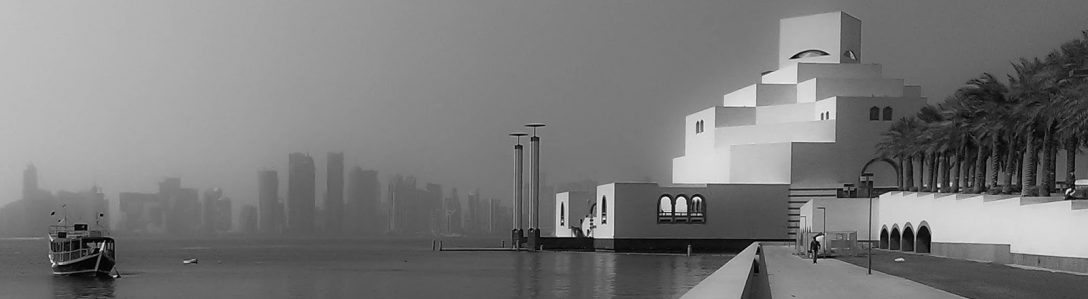
My brother ended up staying for 10 days. During that time, I showed him around Doha, when we weren’t watching football matches. We watched US vs. Wales at a fan zone in my neighborhood, even though I had three tickets to the match. I hosted a Thanksgiving dinner for other American expats in my building, and we watched a football match. My brother and I visited the Museum of Islamic Art, the Qatar National Museum, and Shadows Travelling on the Sea of the Day art installation in the north of Qatar. Then after our adventures, there would be matches to watch in the evening and at night. In the first week of the World Cup, I watched more football matches than I had in my entire 46 years of life.
Eventually, it was time for me to attend my first match at the Lusail Stadium for the Portugal vs. Uruguay. My brother would sit with my friends in the category 3 seat while I sat in the category 4 seat in the nosebleed section with the other residents. My brother thought that maybe at the half I could come and join him or that he could come and join me. However, the gates didn’t provide access to all sections of the stadium. Basically, the gate that I entered only provided me with access to the category 4 seats. If I wanted to join my brother, we would have to exit the stadium, and at that point, we would not be allowed to reenter. So, I enjoyed the game by myself in my three empty seats. Then with about 10 minutes left in the match, I decided I was going to leave early to beat the rush. My brother wanted to stay for the entire match, so I told him that I would meet him at home. Thus, I began my long walk home.
At first, I thought that I would get out the stadium, cross the Lusail Boulevard, and call an Uber. However, the Ubers that I called kept getting stuck in traffic, so I continued walking in the direction of my apartment. Then I tried using the e-scooters that I saw on my walk, but the scooters wouldn’t activate because they were in a scooter free zone near the stadium. So, I continued walking, until I got to the edge of my neighborhood and was finally able to activate a scooter which I rode the rest of the way home. After my long trek, I entered my apartment and sat down; then 5 minutes later my brother walked into my apartment. It would have taken me the same amount of time had I watched the duration of the match and rode the metro back to my apartment.
The next day after the Portugal vs. Uruguay match, my brother had to fly out, so we spent the morning walking around the Pearl. Then we rode the metro to Hamad International Airport, but I could not accompany him the entire ride because I had to get out at the Doha International Airport and pick up two friends from Saudi Arabia who would be staying with me until the end of the week. HIA was being used for the majority of international flights while DIA (which was not in use before the World Cup) was being used to handle flights from other GCC countries, like Saudi Arabia, the UAE, or Kuwait.
My two Saudi friends had a random ticket for matches that week to be able to enter the country, but the match that they really wanted to see was Saudi Arabia vs. Mexico, which I had two extra tickets for. The Saudi fans were very excited because their team had defeated Argentina in the first match. This was quite the upset and was so significant that a national holiday was declared in Saudi Arabia. After picking my friends up at DIA, I continued to play the host and revisited the sites where all the fans were gathering like Msheireb, Souq Waqif, and the Pearl.
Through discussion with other fans, my Saudi friends and I discovered that security wasn’t checking the category of the fans on the tickets, and as long as there were enough tickets, international fans were allowed to sit in the category 4 ticket area. So, I entered the names of my two friends on my extra tickets, and the night of the Saudi Arabia vs. Mexico match, we headed to the Lusail Stadium. Sure enough, this strategy worked, and my two friends were able to join me for match.
Unfortunately, the Saudi Arabia vs. Mexico match was quite one-sided. Mexico was a more aggressive, scrappier team and quickly took the lead in the first half and kept it for the rest of the game. However, Saudi Arabia scored one goal, and because of the point system for advancing, Mexico would not be moving forward to the next round of the tournament. This made for a very somber end of the match. Neither Saudi Arabia nor Mexico had anything to celebrate, so all the fans disappointedly exited the stadium. Still, my Saudi friends took solace in the fact that their team had beaten Argentina and were looking forward to attending other matches. One of them sat with me during the Brazil vs. Cameroon match. So, even though they showed up with one ticket for matches, they were both able to see three different matches during their stay with me. Unlike me, though, they didn’t have five weeks off of work. Therefore, after the Brazil vs. Cameroon match, they took a flight back to Riyadh so that they could return to work.
After hosting my brother and Saudi friends, I welcomed a couple days to myself. I stayed in my apartment and watched the matches on TV. Because football isn’t as fast paced as say basketball, I didn’t have to watch the games as closely. If the announcers became animated, I would look up from my phone, reach for my glasses, and could watch if a goal was kicked or not. This isn’t the level of engagement of a true fan, but again, until this tournament, I had only truly watched one World Cup football match in my life.
A few days after being alone without any guests to host, I received a Whatsapp message from a friend asking if would be willing to host an Argentinian. How did she know this person? Turns out, he was a friend of her friend. At first, I was a little leery about hosting a random person, but I had the space and would enjoy the company. I trusted my friend’s friend, so ok, why not? The next day a very affable Argentinian showed up at my apartment. His name was Federico.
Federico had come to Doha on the very first day of the World Cup, and his plan was to stay for the duration of the tournament. He had tickets for the last match of the World Cup, and it was his hope, along with those of his countrymen in Doha, that Argentina would be playing in that match. Still, they had to win two matches for Federico to have the possibility of seeing his team play in the final round.
Federico was a young guy in his early thirties. We hung out the first day, but for the rest of his stay at my place, he would be out late and would get back at 4 to 6am. He would get up at around 11am, and then he and I would discuss his adventures the night before. He always had a funny story about where he would end up during his long nights. However, on the day of the Argentina matches, this was a serious matter. He would get up, shower, and bid me farewell, for he had to meet up with his countrymen, and they would perform football rituals and psych themselves up for the matches. Some of the Argentinians quit jobs and sold their cars or other valuable possessions to finance their World Cup trip. For them, this tournament was a very big deal, and as Federico noted, if Argentina won the World Cup, babies would be made and his country would be like Switzerland for the next year. Everyone would be happy, and that neighbor you can’t stand would be your best friend, and that family member you normally squabble with would have nothing to argue about with you—so great was the anticipated washback of World Cup victory for his country.
Having Federico as my guest gave me a new perspective on the World Cup, and I was able vicariously to invest in the rest of the tournament through his eyes. On the day of the Argentina matches, I would not wish his team luck because I didn’t want to jynx them, so I would only tell him, “I hope that you have good memories of tonight.” That seemed like a general enough statement, and it turned out that my statement didn’t adversely affect Argentina from advancing to the end of the tournament.
During one of the rest days between matches, a friend of mine in the building, who was also hosting two Argentinians, decided to have a BBQ, so she and her guests bought beef and chicken, and they grilled down by our buildings pool. I invited Federico and a few of his friends, and there was a very spirited party of people eating and drinking down by the building’s pool. One of the Argentinians thanked my friend and me for our hospitality, and I told him, de nada. I had travelled to many countries and was on the receiving end of enough hospitality that I wanted to return the favor. I wanted all visitors to Qatar to have good memories of the tournament and the people hosting and attending it.
The day of the Argentina vs. France match, Federico was hyper focused on the match. His plan was to attend the 6pm match and then fly out at 1am afterwards, so he packed all his belongings before heading out. I bade him my customary farewell before he departed, and he presented me with an Argentina jersey as a token of his appreciation for me hosting him. Since the match was streaming for free on Youtube, I watched it from the comfort of my couch.
As we all know now, the final. match was very dramatic. Argentina took the lead in the first half with two goals, but in the second half, the French striker Mbappe scored two goals within two minutes of each other. Then in the second overtime, Argentina and France each scored another goal before heading into a penalty shoot-out when Argentina was finally able to score enough goals to secure a victory. I was super happy for Federico and Argentina because I knew how much this victory meant to them.
However, because of extended final match and because the end of the tournament coincided with Qatar’s National Day, Federico couldn’t escape from the Lusail Stadium in time and missed his flight. I told him he was welcome to stay with me until he could secure an affordable ticket back to Barcelona.
As I write this reflection of my experience with the World Cup, Federico is either still trying to resolve his flight situation or out with the other Argentinians who also couldn’t make their flight the night after the final match. Even though he is welcome to stay with me until his situation is resolved, I know that he would like to get home. It’s no fun to be stuck at the site of a party once it is over and everyone has left.
Most of the World Cup attendees have departed from Doha. There is still a trickle of people with rolling luggage walking the streets to a metro stop. However, Qatar has already started the process of taking down the temporary infrastructure that it built for the World Cup. Fencing and barricades that were used to steer and corral fans have been removed. The corniche, which was entirely for pedestrian traffic during the tournament, has been reopened for car traffic. Major outlet stores have been removing the abundance of FIFA-related products from their shelves. The party is now officially over.
So, after all of hubbub and controversy surrounding the World Cup, was it worth it? Likely, that depends on who you ask.
For football fans around the world, there were a lot of upsets in the early rounds of the tournament making for some very dramatic matches. No one thought that Saudi Arabia would win against Argentina, USA would draw against England, or South Korea would defeat Portugal. Morocco advanced to the semi-finals after defeating some very good teams and rallied the African and Arab fans. This was first time that an Arab country had made it this far in the tournament. (Personally, I wished Morocco had played against Argentina in the final round.) Additionally, five of the matches were decided by penalty shootouts, including the final match between Argentina and France. This made for some white-knuckle matches for diehard and casual fans alike. Finally, regarding the final match of the tournament, you couldn’t have scripted a more dramatic showdown between two teams. On one side the Argentina team was built around its legendary player Lionel Messi, and on the other side there was the 23-year-old rising superstar Kylian Mbappe and the defending World Cup champions from France. Argentina hadn’t won a World Cup since 1986, and this tournament might be that last time that Messi might have played for the Argentina team. In sum, there was a lot of good football during World Cup 2022, or as a friend of mine remarked, “good theater.”
For football fans living in or visiting Doha, this World Cup was the first time that all 32 countries of fans could interact in one space. All the matches were easily accessible, and during the group stage, it was possible to attend multiple matches in one day, if one was so inclined. A friend of mine, who is more passionate about football, attended over 17 matches during the tournament. If you live and breathe football, Qatar was the tournament you needed to attend. You would have had the chance to see all the current football heroes like Messi, Ronaldo, Neymar, or Mbappe play in an hour radius of one another. From November 20 to December 18, Doha was the nexus of the football universe.
For Qatar, they hosted an exciting and successful World Cup. Now, despite the enjoyability of the tournament, the monetary return on their $220 billion dollar investment isn’t likely even close. However, for Qatar, the World Cup likely wasn’t about making a profit. Rather, it was probably about achieving an ambitious goal that it set for itself. Could an LNG-rich Islamic micronation host one of the most important sporting events in the world? Yes, it could. Qatar has now secured a spot in sports history as the host country of the World Cup 2022, a first for the country and a first for the Gulf region. In addition, the wider world is now more familiar with Qatar, and the open-minded who visited the country have a better appreciation for the hospitality and friendliness of its people. The World Cup was a wonderful opportunity for people of the world to learn more about the real Qatar. After the World Cup, the stadiums might be repurposed or fall into disuse, but the infrastructure that Qatar has built, like the metro and Lusail City, will continue to develop and be used by locals and residents of Qatar. The coffers of Qatar run deep and the costs of tournament were not paid by the citizens or residents of the country, but they all will be able to enjoy what was built and initiated for the tournament for the foreseeable future.
For the critics of Qatar and World Cup 2022, they will never be happy that Qatar hosted the tournament nor satisfied by any changes the country made to address their concerns. In their eyes, Qatar will always be a corrupt, wasteful nation that exploits its migrant labor force, oppresses women with outdated religious practices, and is out of step with the rest of the developed, enlightened world when it comes to LGBTQ+ issues. They will never consider how much the Qatar has grown and changed throughout its recent history and want the country to abide by standards that they determine, and in many ways, fall short of themselves. Hopefully, the people calling for the boycott of Qatar and World Cup 2022 didn’t watch any matches during the tournament nor enjoy the football that was played. (And, yes, I freely admit that I am an apologist for Qatar.)
For me, the World Cup 2022 has been a once in a lifetime experience. I had the chance to establish myself in the country during its preparation for the tournament and watched Doha transform itself. During the tournament, I could venture out from my apartment and participate in the festivities or watch the matches from the comfort of my couch. I was able to host several guests during the tournament and discuss with them my life and perspective in Qatar. I watched multiple videos on the history and importance of the World Cup to the wider world and now can better appreciate the significance of football and the World Cup tournament. In my lifetime, there will probably not be another time in which a micronation is awarded the chance to host the tournament, so I will never have the chance to enjoy a future World Cup with the same amenities as I currently have—which is kind of sad.
The World Cup 2022 was one of the opportunities that I planned for when I made the decision to uproot myself and move to Qatar, and now it has concluded. Now what do I look forward to in place of this once in a lifetime opportunity? As an Argentinian recently told me, “Life is what happens between World Cup tournaments.” I never measured out my life in this manner before, nor will I; however, the streets of Doha and my life that I built here feel a little bit emptier now that endorphin rush from the beautiful game has worn off.
Photo by Fauzan Saari on Unsplash

 opusculum